

 English
 Español
 Français
 Italiano






- Alaskan Yachts
- Azimut Yachts
- Back Cove Yachts
- Beneteau Yachts
- Benetti Superyachts
- Bertram Yachts
- Boston Whaler
- Broward Yachts
- Buddy Davis Sportfish
- Burger Yachts
- Cabo Yachts
- Catamarans
- Carver Motoryachts
- Center Console
- Chris-Craft Yachts
- Cruisers Yachts
- DeFever Trawlers
- Dufour Sailboats
- Fairline Yachts
- Feadship Yachts
- Ferretti Yachts
- Filippetti Yachts
- Formula Yachts
- Fountaine Pajot Cats
- Grady-White
- Grand Banks Trawlers
- Hargrave Yachts
- Hatteras Yachts
- Hinckley Picnic Boats
- Horizon Yachts
- Hydra-Sports
- Intrepid Boats
- Jarrett Bay Sportfish
- Jeanneau Yachts
- Kadey-Krogen Trawlers
- Lazzara Yachts
- Lekker Boats
- Luhrs Sportfish
- Marlow Yachts
- Maritimo Yachts
- Marquis Yachts
- Mazu Yachts
- McKinna Motoryachts
- Meridian Yachts
- Midnight Express
- MJM Yachts
- Mochi Craft
- Neptunus Motoryachts
- Nordhavn Trawlers
- Nordic Tugs
- Numarine Yachts
- Ocean Alexander Yachts
- Ocean King
- Offshore Yachts
- Outer Reef
- Oyster Sailing Yachts
- Pacific Mariner Yachts
- Palmer Johnson Yachts
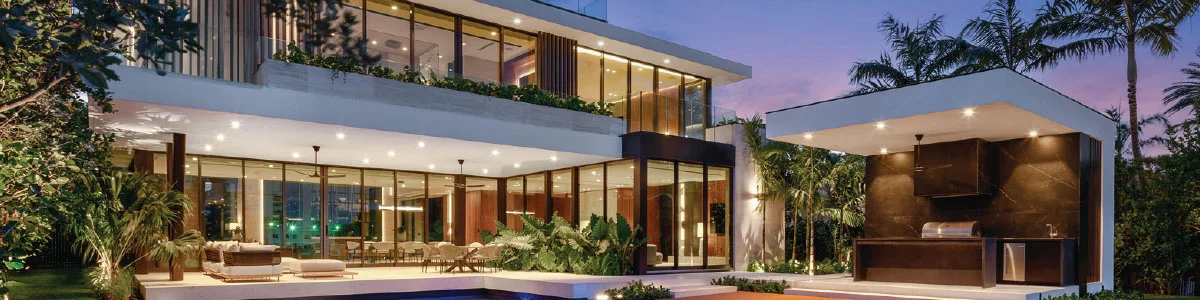
Miami Nice: SDH Studio Blends Architecture, Interiors, on Miami Beach
Since Stephanie Halfen established her Miami Beach studio in 2012, she’s designed and built 71 high-end custom homes… and counting
This article was written by Michael Welton. Photography courtesy of Mike Ruiz @legendaryproductions.
Seventy percent of them feature docks. “The majority of our projects are on the water, so having a dock is part of the experience,” she says.
The firm’s newest project—a home on a canal in Miami Beach—is no different. There, a 31-foot dock is part of an integrated package of architecture, interior design, and landscape in search of a sophisticated owner. Its dock will accommodate a yacht that stretches out 70 feet.
The equal attention paid to each area of the property is indicative of the client-driven philosophy developed by Halfen and her firm, SDH Studio. Halfen arrived in the U.S. in 2009 after receiving a degree in architecture from Simón Bolívar University in her native Venezuela. She later graduated with a second degree in interior design from New York’s Parsons School of Design. What started as a one-person firm now includes 35 people, with 40 projects currently in design, 14 of which are on the oceanfront in Florida, The Bahamas, Mexico, and Panama.
Her intent is to create homes that are spectacular, timeless, and manageable, with low maintenance. “We want to create the kind of space that changes people’s lives for the better,” she says.
The firm’s newest project—a home on a canal in Miami Beach—is no different. There, a 31-foot dock is part of an integrated package of architecture, interior design, and landscape in search of a sophisticated owner. Its dock will accommodate a yacht that stretches out 70 feet.
The equal attention paid to each area of the property is indicative of the client-driven philosophy developed by Halfen and her firm, SDH Studio. Halfen arrived in the U.S. in 2009 after receiving a degree in architecture from Simón Bolívar University in her native Venezuela. She later graduated with a second degree in interior design from New York’s Parsons School of Design. What started as a one-person firm now includes 35 people, with 40 projects currently in design, 14 of which are on the oceanfront in Florida, The Bahamas, Mexico, and Panama.
Her intent is to create homes that are spectacular, timeless, and manageable, with low maintenance. “We want to create the kind of space that changes people’s lives for the better,” she says.
That means defining a project as an entity connected with a number of design disciplines. It’s an approach that appeals not just to end users, but to developers, too. And, because the firm is a developer itself, SDH knows what that market wants and expects, and is well aware of the costs.
“Overspending is not necessary because the integration we get between disciplines is extremely thorough,” says Halfen. “It minimizes conflicts—because the big ones are addressed early.”
This newest Miami Beach home was designed for a Canadian developer who wanted a high-end residence pairing bold architecture with laid-back coastal luxury—and would be desirable on the market.
“He pays a lot of attention to detail,’ says Claudia Fleischman, SDH’s lead interior design for the home. “For everything—aesthetics, design, and budget—we worked with him for the best end result.”
The first challenge was to maximize the buildable area with a 7,000-square-foot home on a 14,200-square-foot lot, and deal effectively with Miami Beach codes. “On that lot we had to have 14 trees and half of them had to be native,” says Juan Ramón Pacheco of ecopacheco, the landscape architecture firm that’s worked with SDH on 60 homes to date. “There are 550 shrubs, and half of these had to be native as well.”
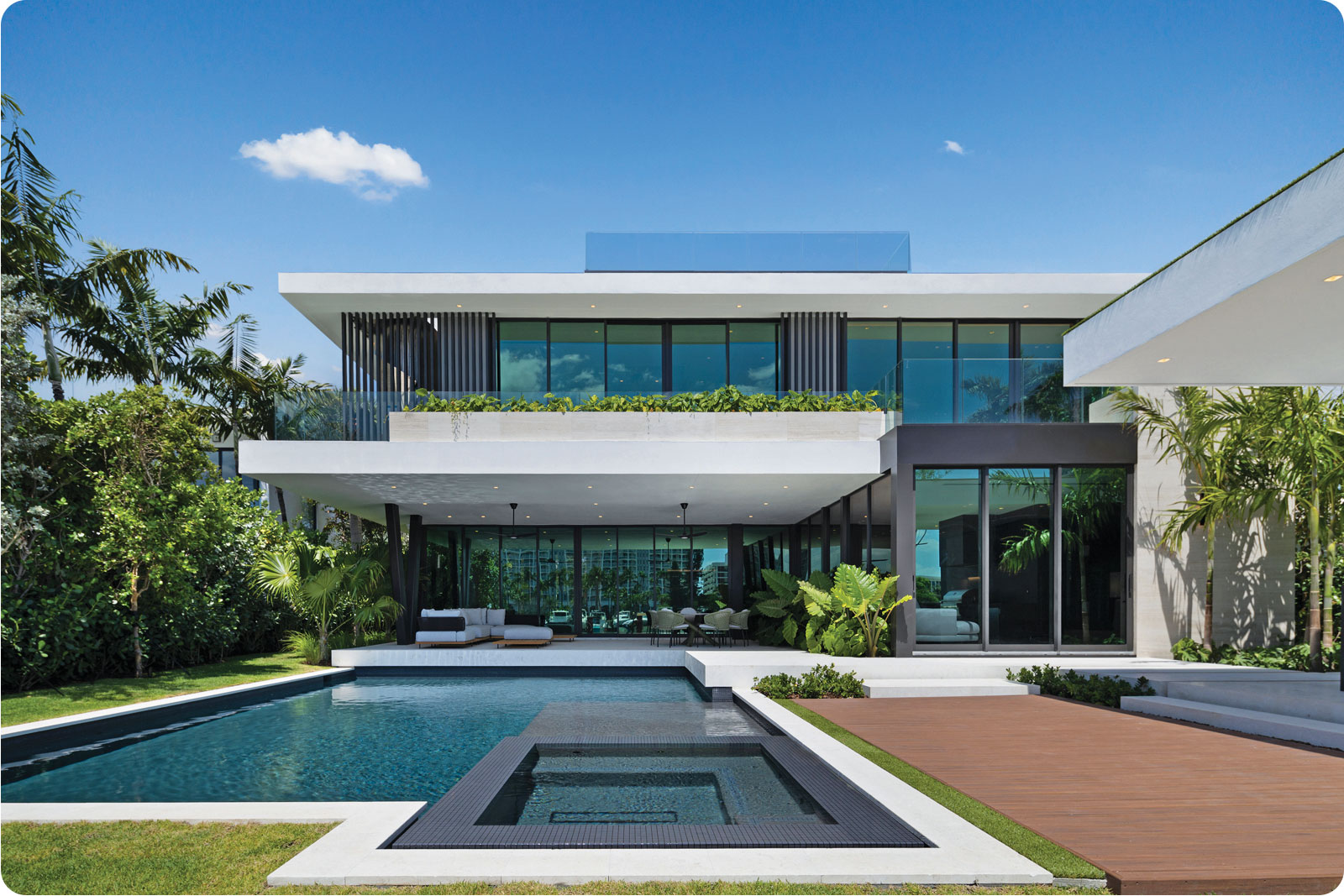
His landscape design addresses the scale and proportion of the home as much as it’s viewed from the outside as it is from the inside. “We wanted to complement the architecture of the house and add value to it without covering it up,” he says. “So, you’re always looking at the greenery and the water from the inside.”
Pacheco also connected the interior experience with exterior elements. “You don’t have to turn lights on, because of all the natural light—from the moment you wake up and walk from the bedroom to the kitchen for coffee,” Halfen says. “Wherever you turn, you see something beautiful.”
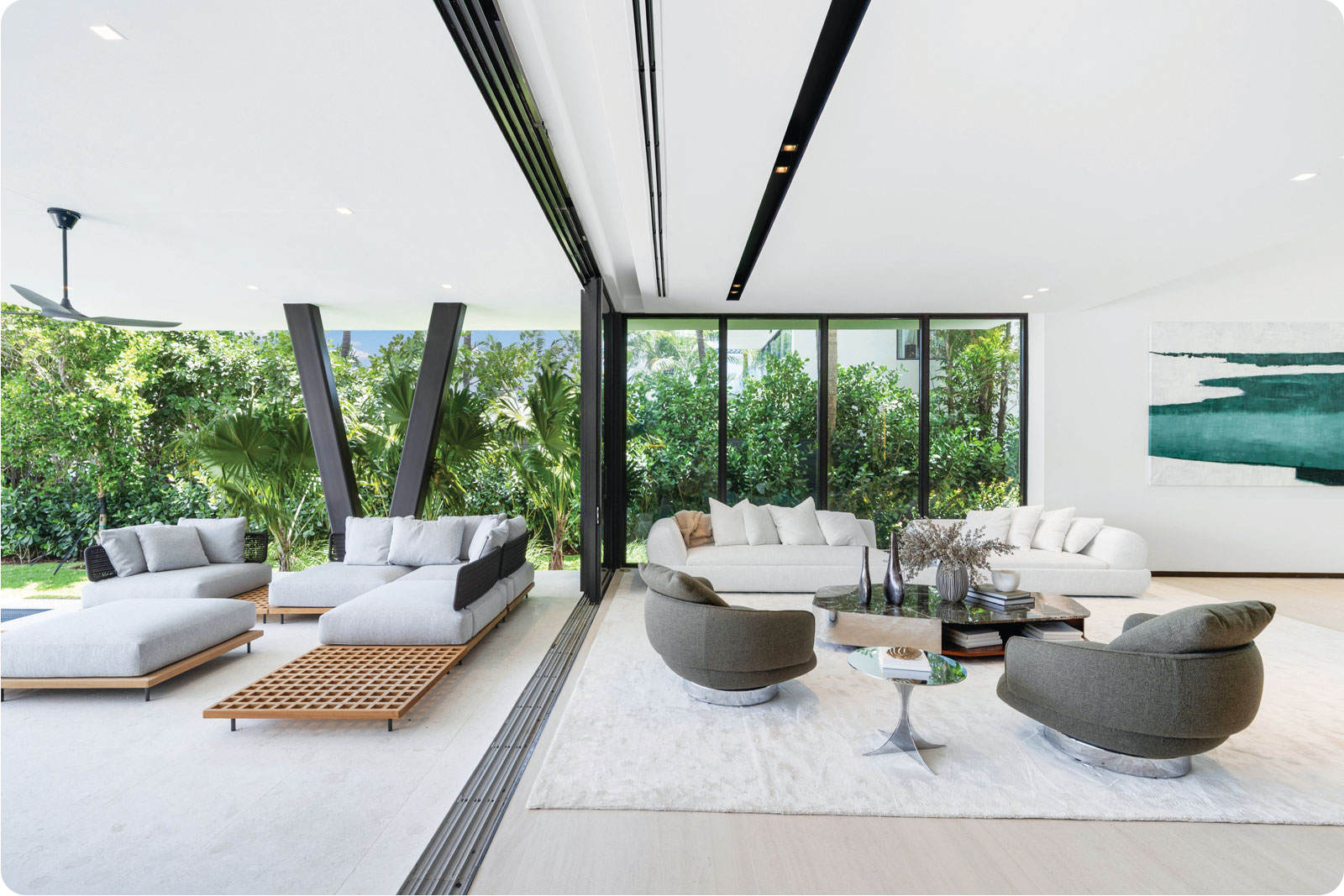
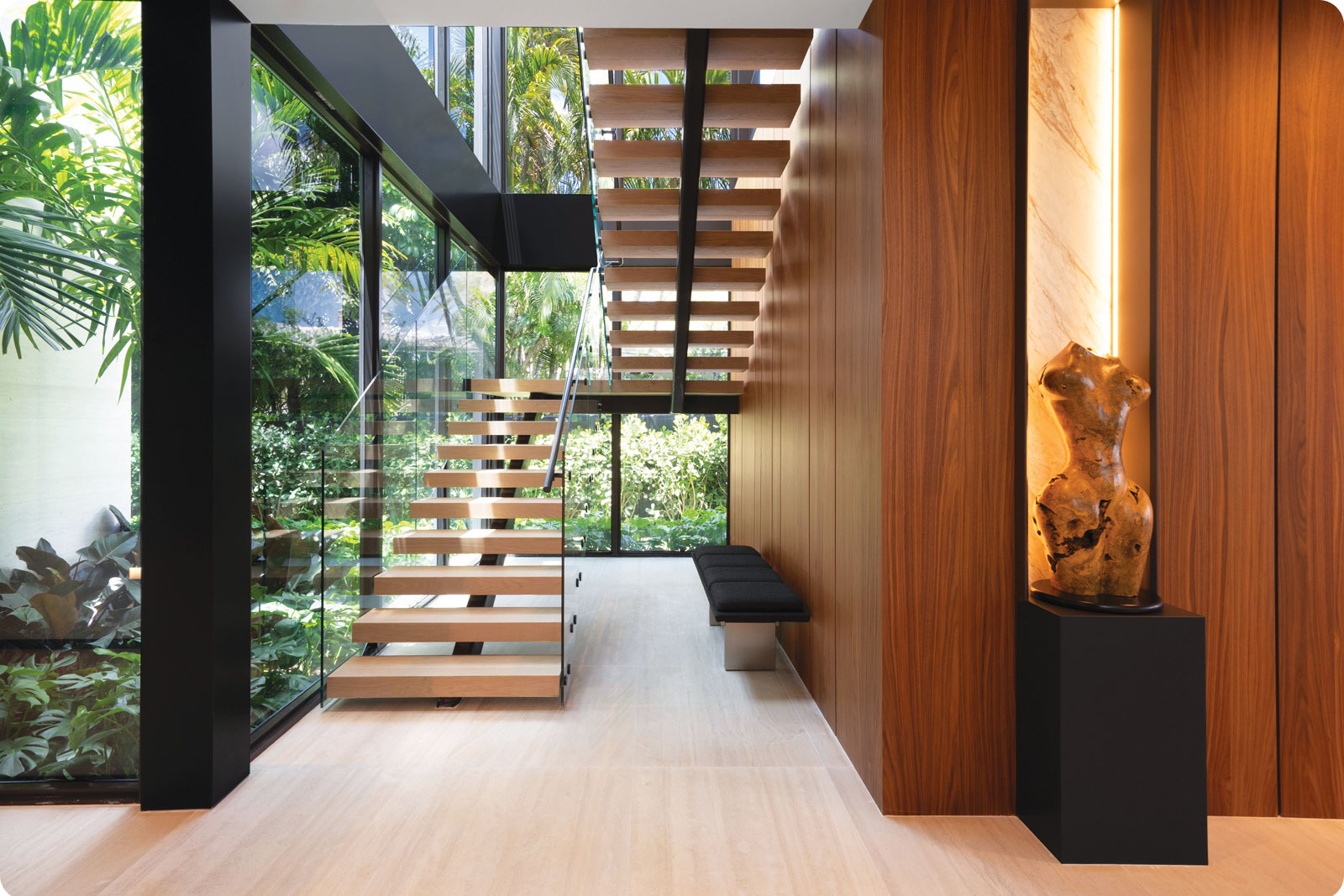
An exterior courtyard surrounds the stairwell, while custom millwork and double-height, 10-foot-high ceilings rise above living, dining, and kitchen areas. Double-height bar areas are 22 feet tall.
When the interior design team received the project, the architecture of the house was already designed, so they started with what they call the “sculpted voyage”—a display of light and shadows that weave
throughout its volumes. “As you enter the house you’re greeted with a double-height wall space that features the bar and sculpted staircase,” Fleischman says. “If you keep walking to the kitchen, you’ll find a stone island balanced with the sculpture of the stairs and framed views of the canal.”
At the same time, light and shadows connect with views of the canal outside, so social areas on the inside look to the outside, and vice versa. “There’s the entry from the street by car, and at the same time you can come in from the canal and a few other places like the living and dining areas,” she says. “The most important social areas are connected to the site.”
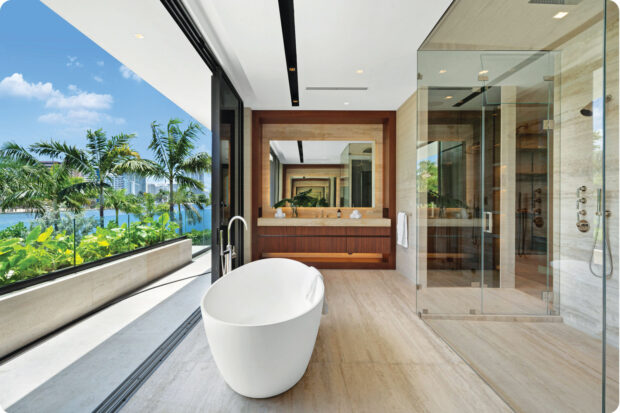
The home’s material palette of natural stone and wood hails from Mexico, Italy, and Portugal. The exterior is clad in travertine, with aluminum louvers. Inside, custom trim and cabinetry is Italian walnut, with more travertine and marble, and limestone floors.
“You feel like you’re inside sculpted travertine, especially in the baths with the travertine spazzolato, white marble, and Collemandina marble with gold veins,” she says.
Spare and elegant, this home is only missing two key elements: One is a new owner. The other is a yacht for the elegantly designed dock that waits along the canal.
Interested in advertising in the next issue of FRANK Magazine? CLICK HERE

Request a Copy
Share This


Latest News


