

 English
 Español
 Français
 Italiano




- Alaskan Yachts
- Azimut Yachts
- Back Cove Yachts
- Beneteau Yachts
- Benetti Superyachts
- Bertram Yachts
- Boston Whaler
- Broward Yachts
- Buddy Davis Sportfish
- Burger Yachts
- Cabo Yachts
- Catamarans
- Carver Motoryachts
- Center Console
- Chris-Craft Yachts
- Cruisers Yachts
- DeFever Trawlers
- Dufour Sailboats
- Fairline Yachts
- Feadship Yachts
- Ferretti Yachts
- Filippetti Yachts
- Formula Yachts
- Fountaine Pajot Cats
- Grady-White
- Grand Banks Trawlers
- Hargrave Yachts
- Hatteras Yachts
- Hinckley Picnic Boats
- Horizon Yachts
- Hydra-Sports
- Intrepid Boats
- Jarrett Bay Sportfish
- Jeanneau Yachts
- Kadey-Krogen Trawlers
- Lazzara Yachts
- Lekker Boats
- Luhrs Sportfish
- Marlow Yachts
- Maritimo Yachts
- Marquis Yachts
- Mazu Yachts
- McKinna Motoryachts
- Meridian Yachts
- Midnight Express
- MJM Yachts
- Mochi Craft
- Neptunus Motoryachts
- Nordhavn Trawlers
- Nordic Tugs
- Numarine Yachts
- Ocean Alexander Yachts
- Ocean King
- Offshore Yachts
- Outer Reef
- Oyster Sailing Yachts
- Pacific Mariner Yachts
- Palmer Johnson Yachts
Albin 35

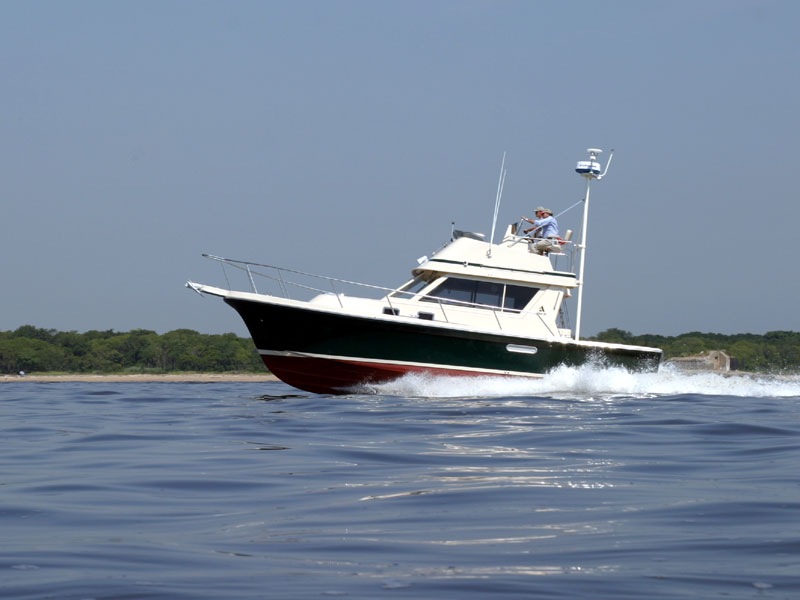
Source: Stuart Reininger, Boating Magazine
Say “Albin” to any of the old-timers who were based at the New York State Marina at Alpine on the Hudson River Back in the ’70s and you’ll get a reminiscent smile. There were a couple of those boxy, Swedish-built 25 footers docked there then. They were aft-cabin cruisers with an identity crisis. They couldn’t decide whether to drift along with their optional mast and ragbag rigs or putter around with their little sailboat-like diesels. You’d smile too.
Now, I know the company’s been reorganized – they build boats in Rhode Island today, but I haven’t crossed wakes with an Albin in quite a while, so when I recently strolled down the dock at the Miami Beach Marina to test the 35 Sedan, I sort of expected a craft that wasn’t quite sure of it’s purpose in life.
Coming a Long Way The lines of the Albin 35, however, create a robust, workboat-like Downeast look. There’s no doubt as to its aspirations. Its big 85 sq ft cockpit says “fish me.” And its layout will allow two couples or a family to keep out of each other’s hair during a long weekend or week’s cruise.
A luxury fisher/cruiser? No. The fit and finish are geared more toward solid dependability than the detail you’ll find on more upscale – and expensive – cruisers. Don’t look for exquisite dovetailing here or the matching burls of exotic woods. What you will find is easy-to-clean upholstery and functional moldings and liners.
Fishing? That cockpit has four built-in rodholders, but if you’re serious, go for the sportfishing package. It includes a bench forward of the flying bridge console, more rodholders and an additional Pompanette seat.
Cruising? The flying bridge – which is often an all-business, leave-me-alone-I’m-driving place – will be more of a skydeck social lounge here. With its 6′ aft settee – which converts to a forward facing bench – center helm seat and flanking back-to-back passenger seats, there’s room for the whole gang to hang out without distracting the skipper.
The view forward from the lower station – an option – is almost as wide-ranging as it is from upstairs. That’s unusual. I’m not a fan of lower stations. They’re rarely used, take up space, and their console often ends up serving as a book or flower stand.
But it works on the 35. I had a clear all ’round view while steering from below and never felt like I was about to slam into something lurking just out of my line of sight.
Our test boat had a hatch cut through the bridge deck. It’s a tight squeeze and I promptly bounced my head off the rim while climbing down. That hatch might be okay if you’re cruising with landlubber guests who will appreciate the support it offers when climbing from the cockpit to the flying bridge, but it can be a noggin-cruncher.
On many other boats of this genre, like the Henriques Maine Coaster 35 – a vessel with similar lines and purpose as the Albin – you can climb unhindered from cockpit to flying bridge. It’s a setup that works. If you’re fishing short-handed and have to dive up and down, the last thing you need is a hatch to squeeze through. But the Henriques makes little pretension to cruising. It opts for more cockpit space for fishing and less living area.
Albin has promised to widen the hatch, but better yet, if you opt for the sportsfishing package, the hatch is eliminated. Like the Henriques, it’s up the ladder and onto the bridge. If anything other than casual cruising is in your plans, go for it.
Plane Pleasure For the pushwater types who’ll be attracted to the 35, the transition to a planing hull should be seamless. Propelled by a pair of 300 hp Caterpillar 3116 diesels, we went on plane at about 1800 rpm. Effortless. I almost had to look at the wake to make sure we were out of the hole. Dropping on and off plane without blast-off drama is a plus if you’re into gunkholing and stop-and-go cruising.
With the 35’s Hynautic hydraulic steering and Morse Controls, you won’t feel like there’s an 18,500 pound boat under you. Handling was smooth. Of course, so was the water in Miami’s Government Cut. Jumping our own wake and others didn’t produce any surprises, but quartering the wash from a passing tug produced a touch of bow steering – not unusual considering the 35’s very modified-V, 13 degree transom deadrise. In seas, this could be uncomfortable running in the trough or downwind. Use the standard tabs to keep the nose up.
Your linehandlers, or yourself if you’re single-handed, will be comfortable any time. A waist-high stainless steel bow rail, 8″ wide sidedecks with deep, molded in nonslip and solid 10″ stainless cleats – including that all important amidship cleat – say design seamanship. Twin deep, self-draining and ring bolted anchor wells flank the windlass mount. It’s prewired with 00 guage wire – just right. The anchor well covers, however, are secured with will-break-sooner-or-later plastic twist latches.
The bow pulpit isn’t integrated as most are. It’s a separate piece through-bolted and sealed with 3M 5200. An excellent idea.. Trash an integrated pulpit and you’re looking at four figures and climbing depending on the ancillary damage.
Braveheart The 35’s construction is a solid and proven formula. Following a gel and skin coat, the hull layup consists of alternating layers of chop and 17 oz and 18 oz mat cored with ¾” Baltek. The running surfaces and strakes are solid glass. With overlaps, you’ll have eight layers over the keel. The deck is Baltek balsa cored except where hardware is bolted through. There, the backing is solid wood.
If you buy a 35 and happen to cruise by my old marina in Alpine, stop in and introduce the folks to this real-world cruiser – that’ll wipe the smiles off their faces.