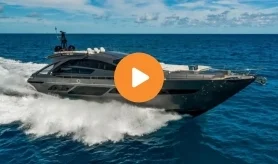

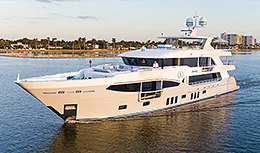

If you follow Marine Traffic as closely as we do, you know the feeling. You check the app, and suddenly one of the most talked-about yachts of the decade is sitting right down the street.
That's exactly what happened this week when the 114-meter Nausicaä, delivered by German shipyard Lürssen in 2026, pulled into Fort Lauderdale. At 375 feet, she's not just another superyacht passing through. She might be the most significant delivery the industry has seen in the last ten years, so once we heard she was local, we had to go take a look ourselves.
A Design Unlike Anything Else Afloat
Nausicaä was designed entirely, inside and out, by Australian industrial designer Marc Newson, best known for his work with Apple, Louis Vuitton, and Ferrari. That's an unusual approach at this scale, since exterior and interior design are typically split between different studios. The result is a yacht that feels less like a traditional custom build and more like one single, cohesive vision from bow to stern.
The signature move is glass. A continuous ribbon of glazing wraps around the bow and the entire upper superstructure, doing away with the flat panels and hard edges you'd expect on a vessel this size. Every curve, from the hull to the doors to even the exhaust mast, was engineered to avoid a straight line.
Then there's the dome. Perched on top of the yacht is a 56-square-meter glass Skydome, custom-built from hot-bent glass panels, that serves as the owner's private study. Picture sitting up there in the middle of the Atlantic with nothing but stars overhead. It's hard to think of a more dramatic use of space on a yacht this size.
Aft, the functionality is just as ambitious. There's a garage built specifically to house a submarine, plus the ability to bring a sportfish boat right up into the stern. It's the kind of layout that redefines what "amenities" even means on a build like this.
The Real Headline: Hydrogen Power
The most groundbreaking feature isn't visual at all. It's what's happening below decks. Nausicaä runs on a diesel-electric setup, but she also carries a first-of-its-kind fuel cell system that converts methanol into hydrogen to generate onboard electricity, with no combustion and no emissions.
What that means in practical terms is that the vessel can travel up to 1,000 nautical miles with zero emissions, and it can spend up to 15 days at anchor running entirely emissions-free.
It's a real glimpse at where propulsion technology in this industry could be headed. Diesel-electric platforms paired with fuel cells aren't just a talking point anymore. They're floating in Fort Lauderdale right now.
So, What Does Something Like This Cost?
Search around and you'll find estimates landing around $350 million for a build of this scope and innovation.
The real question we're asking: does that number feel high, or low, for a yacht that redefines both design and propulsion in the same build?
Spotted this one locally and had to share it with our community. Let us know what you think she's really worth.