
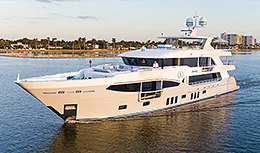

What Is Jumboization?
Jumboization is the shipbuilding term for cutting a completed vessel in half at midship, welding in a new hull section, and reassembling the ship as a longer version of herself. The finished yacht keeps her original bow, stern, and superstructure design, with a fresh midbody section extending her overall length.
The term originated in commercial shipping and naval construction, where it's been used since the late 1950s. Today it's applied across cargo ships, cruise liners, naval submarines, and yes, superyachts.
How Jumboization Works
The process typically follows the same steps regardless of vessel type:
- The yacht enters a dry dock or shipyard hard.
- Shipyard engineers make templates of the cut points, then physically cut the hull in half.
- The two halves are separated.
- A new midship section, prefabricated to spec, is lowered into position.
- The three sections are welded together, systems are reconnected, and the interior of the new section is finished to match.
Depending on the yacht's size and the complexity of the insertion, the process can take anywhere from several months to well over a year.
Notable Jumboized Yachts
SURI: Built in 1978 as a commercial crab boat in the Gulf of Mexico, SURI spent decades fishing under the name Fierce Contender, even appearing on Deadliest Catch. In 2012, her owner sent her to Bay Ship & Yacht Co. in California for an eleven-meter midship extension. She emerged as a 63-meter luxury explorer with a helipad, submarine, and underwater viewing room.
SANDALPHON: Sandalphon began as a 27-meter partial hull abandoned in a Brazilian shipyard. Balk Shipyard in the Netherlands acquired her, stripped her down to bare metal, and cut her in half twice, adding three meters at midship and one meter at the stern. She relaunched in 2017 as a 31-meter explorer.
COCO CHANEL/NADINE: Built in 1961 by Dutch yard Witsen & Vis as Mathilde, she was purchased by Coco Chanel and renamed. In 1988, at Merrill-Stevens shipyard in Miami, she was cut in half and lengthened with a 29-foot midship section, bringing her from 121 feet to 167 feet. She eventually became Jordan Belfort's yacht Nadine and sank off Sardinia in 1996.
Transom Extensions Versus True Jumboization
Not every yacht extension involves cutting a boat in half. The more common variant is a transom extension, where new hull is added to the stern of an existing yacht. Purists distinguish between the two: transom extensions add length at the back, while true jumboization inserts a section at midship.
Both approaches share the same goal, adding usable length to an existing yacht, but the engineering and cost profiles differ. A midship insertion requires cutting through structural bulkheads, engine mounts, and interior spaces, while a transom extension usually only affects the aft deck and swim platform.
FALCON LAIR, a 1983 Feadship originally launched as New Horizon L, is a good example. She's had her transom extended twice, in 2005 and again in 2015, growing from 60 meters to 68.7 meters over her lifetime.
Beyond Yachts
Jumboization isn't unique to the pleasure marine industry. Cruise ships get sliced in half regularly to add cabins and revenue capacity. Royal Caribbean's Enchantment of the Seas went from 916 feet to 989 feet in a single shipyard visit at Rotterdam in 2005, gaining 151 new cabins in the process.
The US Navy has jumboized submarines dating back to the late 1950s. The USS Jimmy Carter received a 100-foot Multi-Mission Platform section during construction, at a contract cost of $887 million on top of the submarine itself.
Why Owners Choose Jumboization
The decision to jumboize a yacht rather than commission a new build comes down to timing, sentiment, and specification. A new custom superyacht typically takes three to five years to design, build, and commission. Jumboization can be completed in a fraction of that time, allowing an owner to keep a yacht she's attached to while adding meaningful volume, range, or amenity space.
Cost varies significantly by project. In some cases jumboization runs well below a new-build price. In others, particularly when the existing yacht is stripped to bare metal and rebuilt, the final cost can approach what a new yacht would have cost. It isn't always a shortcut. But for the right yacht and the right owner, it's a legitimate option.
For yacht buyers and sellers, refit history matters. A jumboized yacht carries a different story than a new build of the same length, and understanding when and how she was extended is part of establishing fair market value. Denison brokers work with jumboized and refit yachts across the global market.