 English
 Español
 Français
 Italiano











- Beam: 10' 10''
- Hull Material: Fiberglass
- Max Draft: 5' 4''
- Displacement: 16,000 lb
- Fuel Tank: 1 x 40|gallon
- Fresh Water: 1 x 95|gallon
- Holding: 1 x 30|gallon


220 views
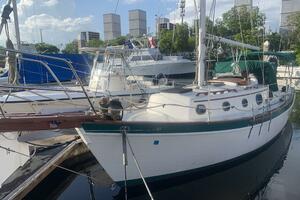
Over the almost five decades since since her introduction back in 1978, the US-built the Pacific Seacraft 37 has earned an enviable reputation as one of the best and most versatile cruisers ever built, and, not surprisingly, it remains in high demand by serious sailors looking for a high quality bluewater cruiser--the boat is brilliantly designed and impeccably executed and is one of the best cruising boats money can buy (and it helps to have plenty of it you want a new one--they're now well over $700k fit out, and the build time will be measured in YEARS!).
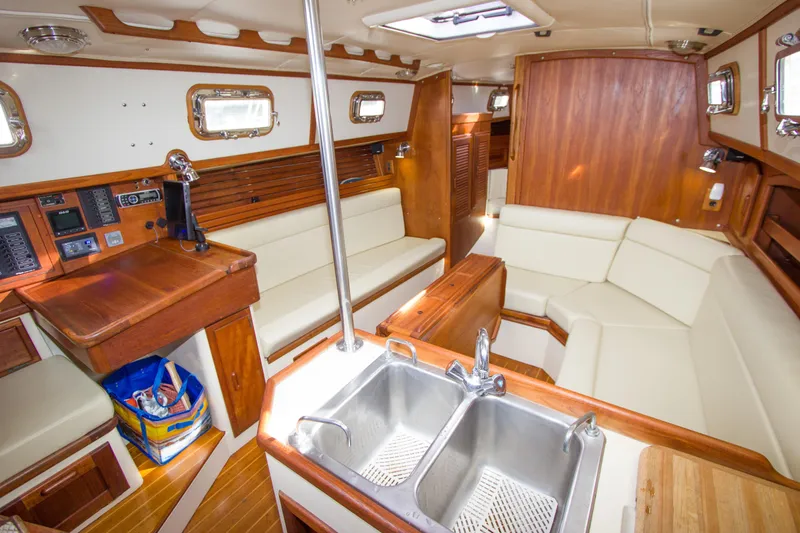
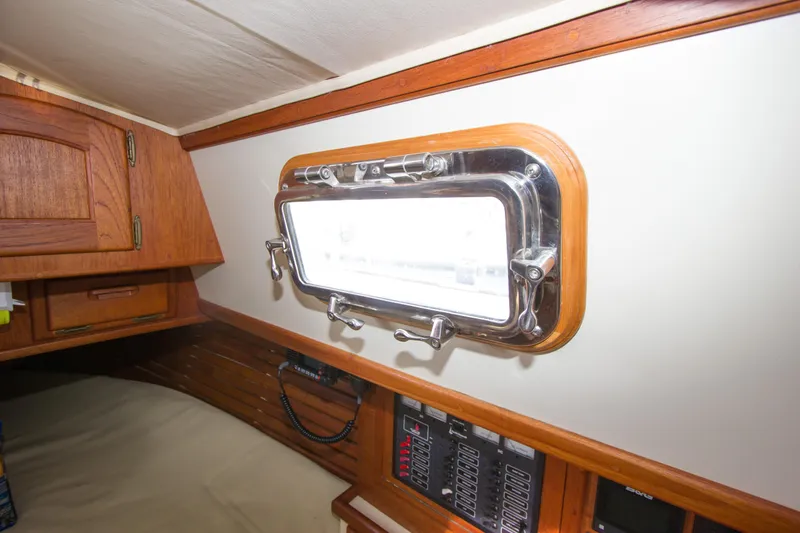
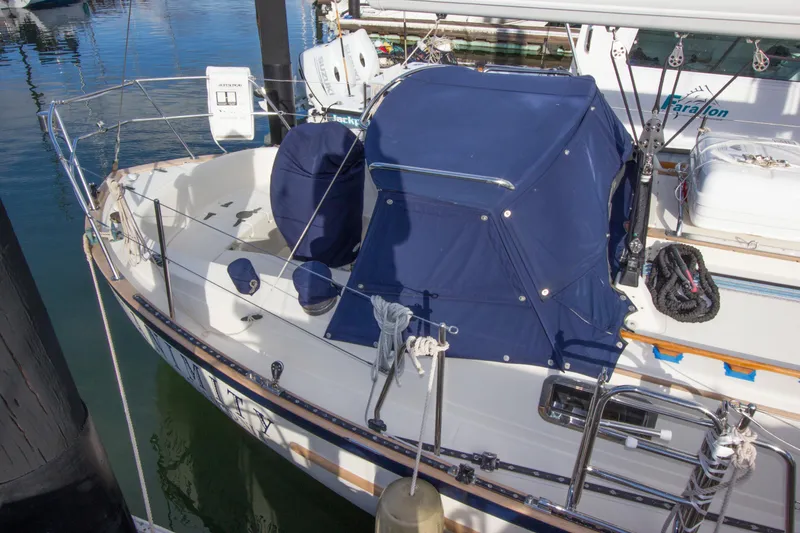
This particular example has always been professionally maintained with an open checkbook and shows practically as new inside and out--she really must be seen to be appreciated (especially the brightwork which was all just renewed and is FLAWLESS, and the stainless steel hatches and portholes that are beautiful pieces of JEWELRY!).
She's also competitively priced, the only 37 currently available in CA (and one of only a handful anywhere on the west coast), and should be at the top of your list if you're looking for a clean cruising boat. Or a perfect day sailer for typical San Francisco Bay conditions--not all Pacific Seacrafts cross oceans! Wherever you're planning to sail, the boat's an absolute delight: she tracks like a freight train, with the convenience and safety of a LeisureFurl main (and of course a roller furling jib) and a heavy duty offshore dodger for calm, cool and collected sailing in all conditions. Last hauled and bottom painted in July of 2025.
Motivated two boat owner, offers encouraged...
Listed by Marotta Yachts of SausalitoTHIS BOAT IS SUBJECT TO AN EXCLUSIVE LISTING AGREEMENT WITH MAROTTA YACHTS OF SAUSALITO 415-331-6200 AND IS NOT OFFERED FOR SALE BY DENISON YACHTING - SAN FRANCISCO. Denison Yachting - San Francisco is merely providing this information in an effort to represent you as a buyer in the purchase of this vessel.
Denison Yacht Sales offers the details of this yacht in good faith but can’t guarantee the accuracy of this information nor warrant the condition of this boat for sale. This yacht for sale is offered subject to prior sale, price change, or withdrawal from that yacht market without notice. She is offered as a convenience by this yacht broker to its clients and is not intended to convey direct representation of a specific yacht for sale.
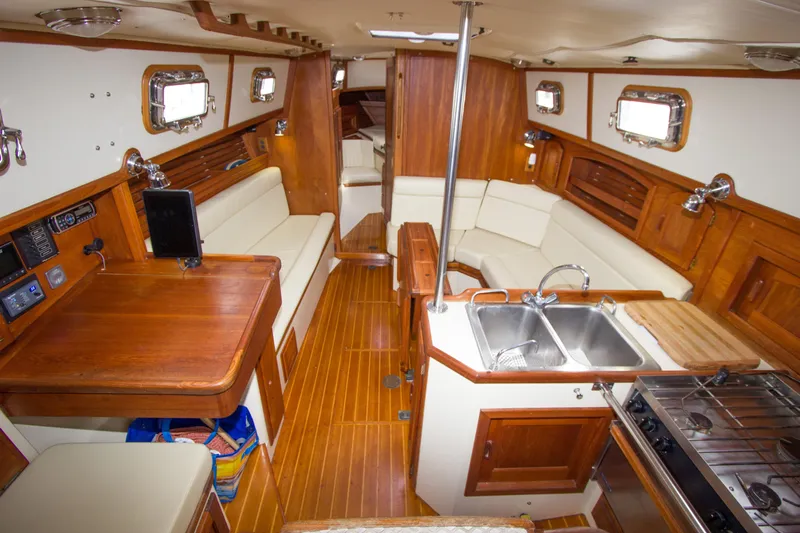
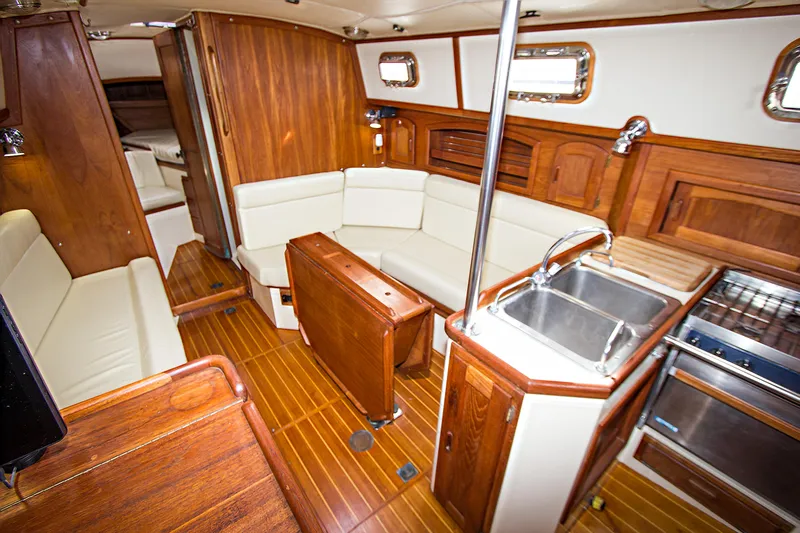
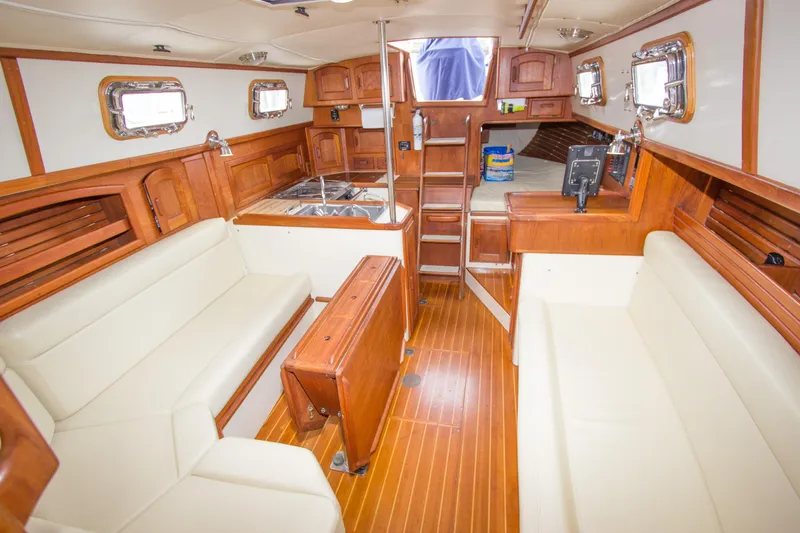
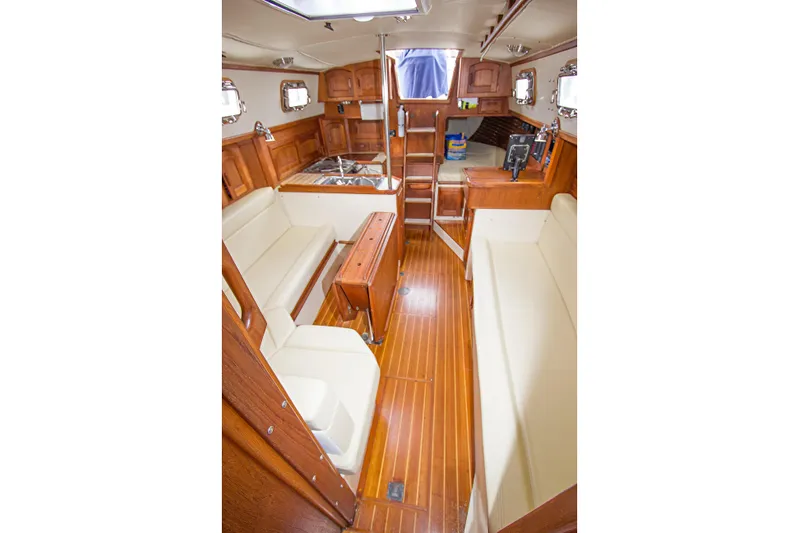
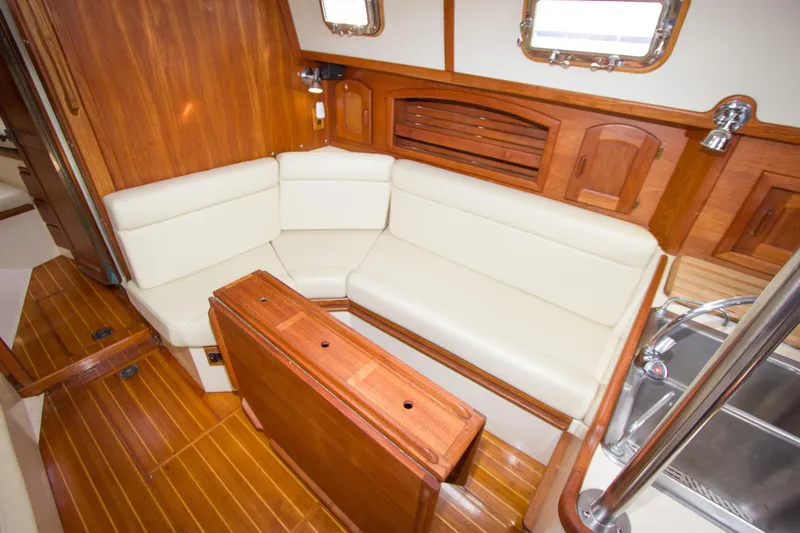
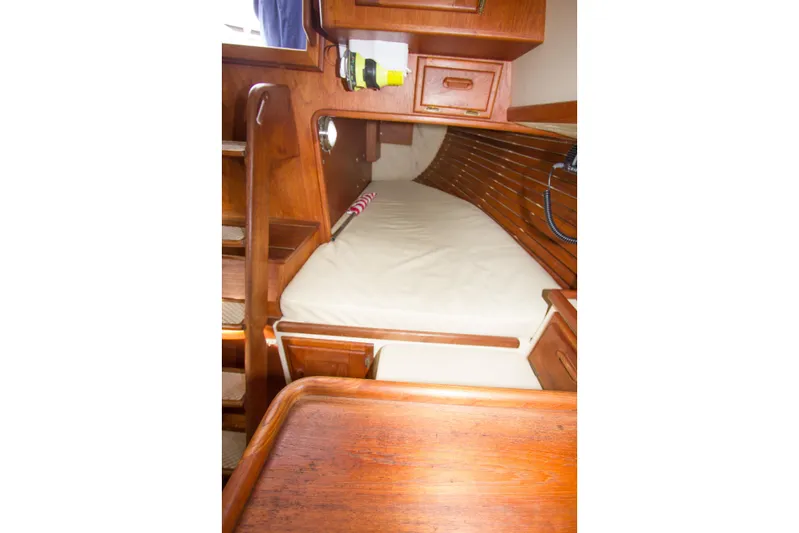
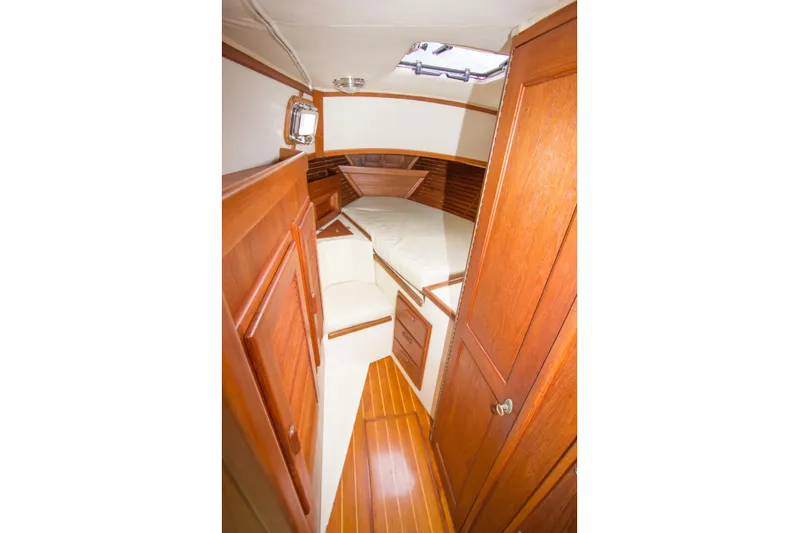
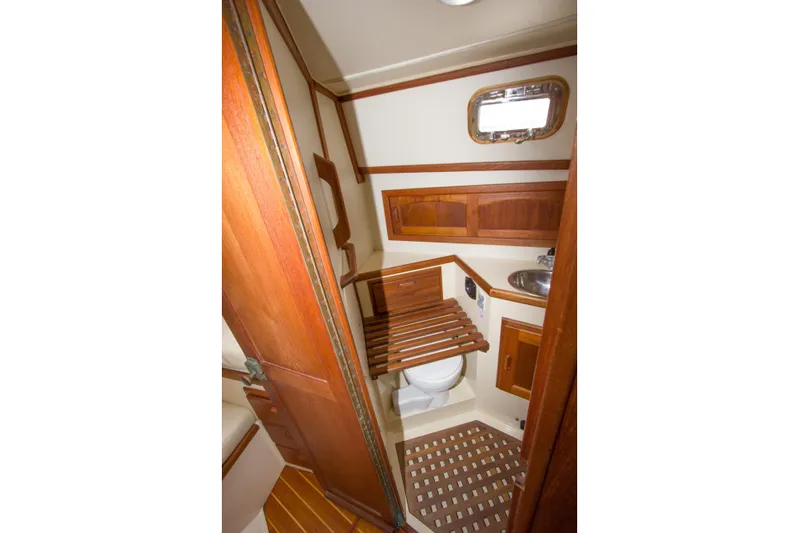
Forward stateroom has offset double berth, built in seat, ample hanging locker space and private access to head. Step aft to salon with L shaped settee and double drop leaf table port, straight settee starboard.
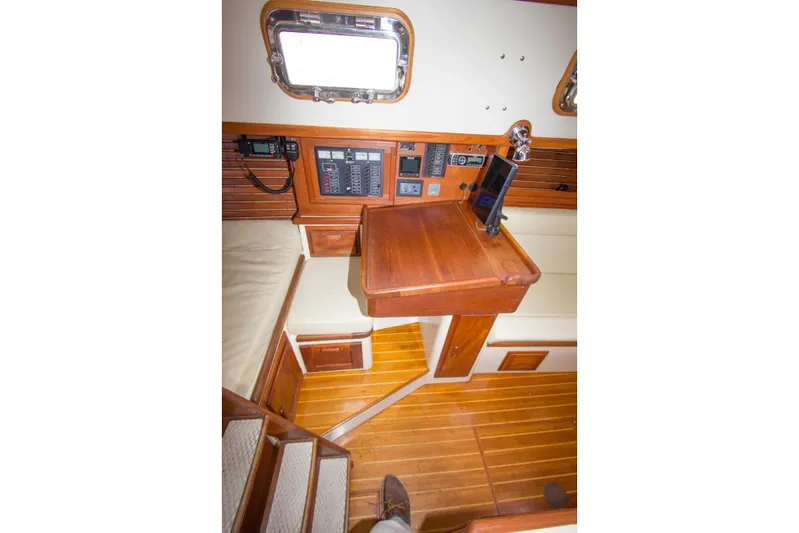
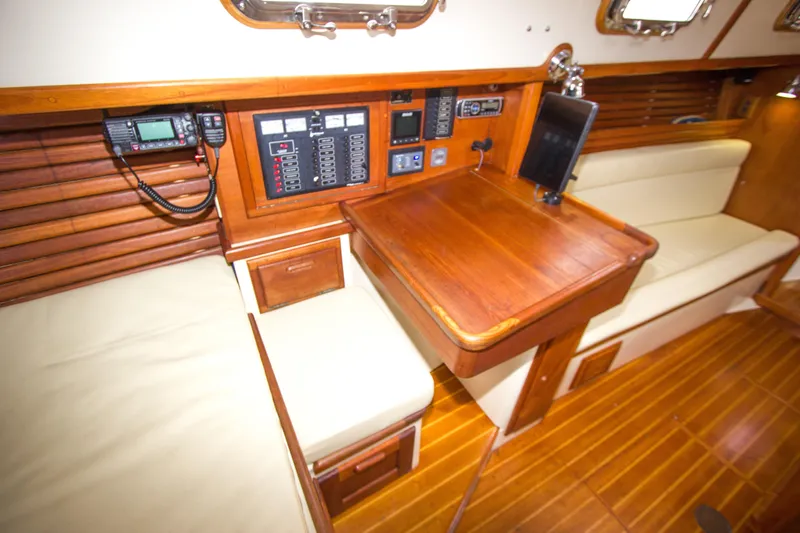
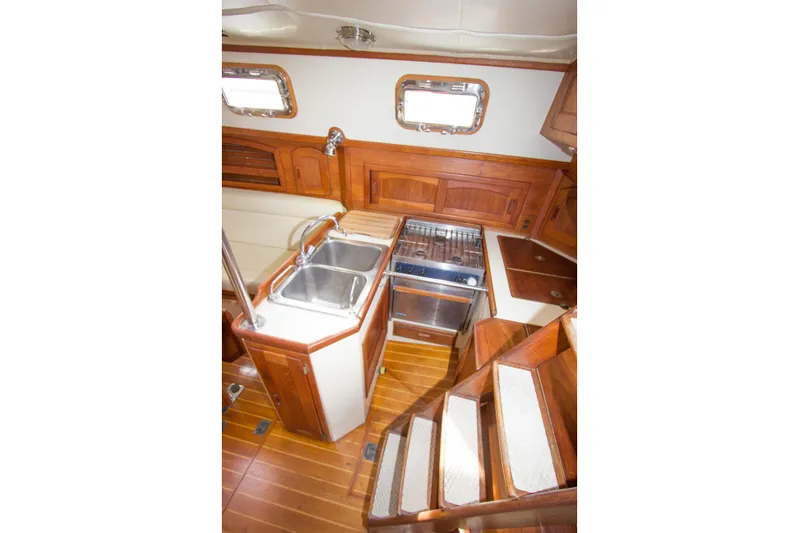
Continue aft to U shaped galley starboard, centerline companionway and nav table and quarter berth port.
Note satin finished solid teak interior shows AS NEW, teak & holly sole, Hella Turbo cabin fans, 6'4 headroom.
Force 10 gimballed three burner propane stove with oven and stainless steel safety bar, deep double stainless steel sinks with hot/cold pressure water (Atwood 6 gallon engine and 110V fired hot water heater), Adler Barbour 12V refrigeration.
Groco Model K heavy duty manual pump head (totally rebuilt in 2011).
110V AC / 12V DC. Thirty amp shorepower service, Vectron inverter/charger and power management system (2024). Three 8D lead acid sealed batteries for house bank, single Group 27 lead acid sealed dedicated starting battery. Seventy five amp alternator.
Instrumentation professionally upgraded with an Orca Navigation system with a redundant NMEA backbone, B&G radar and multi function instruments, Raymarine autopilot, upgraded VHF radio with new antenna and AIS send/receive, 5" Ritchie magnetic compass.
Jensen AM/FM/CD stereo.
Single spreader deck-stepped painted aluminum mast with 1x19 stainless steel standing rigging, Leisure Furl furling full batten heavy duty mainsail with Forespar rigid vang, Harken mainsheet with Harken traveller, Harken boom vang. 130% Ullman jib on Harken Mk III roller furler, staysail also on Harken roller furler, whisker pole stowed on mast.
Two Barient #46 self tailing winches, three Barient #16 winches, all lines lead aft thru seven Lewmar rope clutches.
Jib was resewn in 2023 to reinforce wear areas, boom vang rebuilt with new spring and hardware (2022), traveller rebuilt with upgraded car and blocks (2022), winches rebuilt including the electric halyard winch.
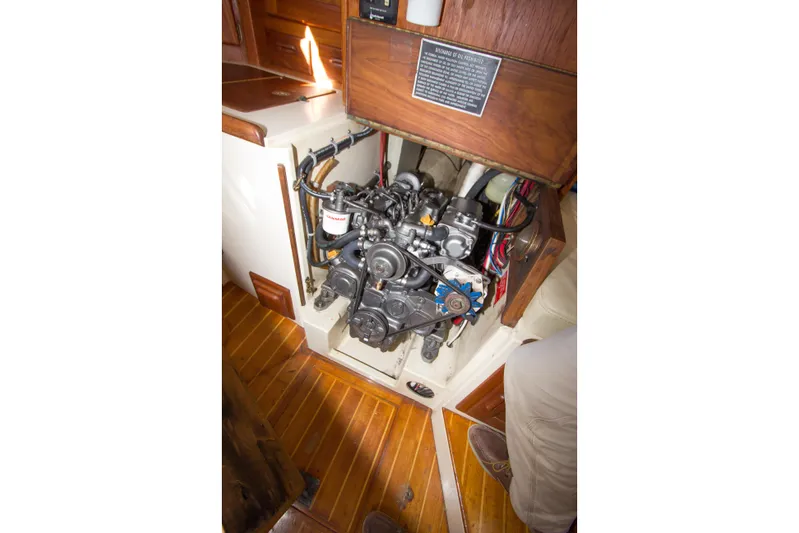
Four cylinder fresh water cooled Yanmar 4JH2E diesel engine in insulated compartment with double Racor 75/500 fuel filters, removable cockpit sole allowed great access to engine, steering system and packing gland. Three blade Flex O Fold prop, Whitlock pedestal wheel steering.
Engine has been regularly maintained by List Marine including rebuild of cooling system to factory spec in 2023--almost $15,000 was spent on the engine between 2023 and 2024.
Hand laminated biaxial fiberglass hull, balsa-cored deck (plywood core with backing plates at hardware mounting points), deck-to-hull joint utilizes both adhesive and stainless steel thru-bolts, vinylester bottom for superior resistance to osmotic blistering, modified full lead keel (standard draft, not the shoal draft ) with skeg-hung rudder, hull color is Oyster White with solid teak rubstrake..
Heavy duty stainless steel stanchions with double lifelines, stainless steel bow, stern and mast pulpit, dodger, stainless steel folding swim ladder.
Extended bow platform with bobstay, 20 lb.Rocna anchor on double bow roller, Maxwell 2200 electric anchor windlass with remote control and ample chain & line rode. Six mooring cleats.
It is a bit unusual for a boat like the Pacific Seacraft 37 to appear in the Used Boat Notebook for the simple reason that it’s still in production. The boats that have been profiled over the years, despite typically long and successful production runs, are no longer available as new boats, which makes them good values on the used market.
Introduced in 1978 the Pacific Seacraft 37, or as many still refer to it, the Crealock 37, is an impressive world voyager, and it continues to be in demand by serious sailors looking for a high-quality bluewater cruiser. Naturally the newer boats will be quite expensive (the base price of a brand-new model is now almost $400,000), but early models sell for less than $100,000.
W. I. B. (Bill) Crealock has designed a slew of fine cruising boats over the years, including the handsome Cabo Rico 38 and the husky Westsail 42. Less well known as a writer, Crealock’s 1978 memoir, Vagabonding Under Sail, is a wonderful book describing his early days sailing all over the world. I remember finding the book at Michigan State University and feeling like I had discovered a hidden treasure.
Surprisingly, the Pacific Seacraft 37 traces its origins back to Clipper Marine. In the mid-1970s, the company began tooling to build a 37-foot bluewater cruiser that would be tough and affordable, something to compete with the Westsail 32. Clipper Marine went broke before any boats were built and the boatbuilding company Cruising Consultants acquired the molds. The result was the first edition of the Crealock 37. Cruising Consultants built 16 boats in 1978 and 1979 before selling out to Pacific Seacraft. The rest, as they say, is history. Pacific Seacraft will soon be launching hull number No. 263. Of that number most have put plenty of bluewater miles under their keels and have nosed their fine bows into harbors all over the world.
First impressions
The Pacific Seacraft 37 marries a traditional look with a quiet but uncompromising attitude. With a shapely canoe stern, sweet sheerline, low freeboard and long bow overhang, the PS 37 is a handsome boat by any definition. However, a closer inspection reveals practical features expressly designed for sea duty. The cutter rig does not include a bowsprit with the potential for rig and structural damage, and all sail controls are led aft to a well-protected cockpit. If good looks alone were driving the design, the trunkhouse might have been lowered. However, Crealock understands the importance of maximizing room below without compromising the basic hull shape and the need for handholds on deck that are located at a useful height. Below the waterline the large fin keel is cutaway fore and aft, the rudder is hung on a full skeg and the propeller is completely protected.
Under sail the PS 37 performs surprisingly well and has logged many fast passages, which may come as a bit of surprise after glancing at performance parameters. The boat’s displacement/length ratio of 334, for example, is nothing to brag about, especially when compared to cruisers like the Island Packet 37 and Gozzard 37, which check in at around 270. This number, however, is very deceptive, since the PS 37 is narrow and heels early, thereby extending the waterline significantly. Also, displacement figures are inherently inaccurate when it comes to cruising boats and the loads they carry.
One admirable aspect of the Pacific Seacraft 37’s performance is that the hull almost never pounds in a seaway and the boat can be easily handled with a small crew. So many times, heavier cruisers turn in faster passages than lighter ones simply because the crew is better rested because it didn’t need to micromanage its boat.
Construction
Pacific Seacraft builds stout boats, and its construction techniques are conservative and well proven. The hull is solid fiberglass, and while the company does offer optional balsa or foam layers, these are for insulation purposes only. Early hulls were not immune to the boat pox that swept the industry in the 1980s, but today’s boats include vinylester resin in the first laminate to prevent blisters.
A full-length molded liner supports the hull with several recesses for bulkheads, floors, furniture fittings and engine beds. There are drawbacks to molded linings: They are hard to secure to the hull, limit hull access and restrict different interior configurations. However, Pacific Seacraft uses numerous bonding points to make sure that the liner is firmly glassed in place. You can’t argue with the results: few if any 37s have reported structural hull damage, even after hard groundings.
The deck is plywood cored, which is unusual in a boat of this quality, but once again, the results speak for themselves; deck delamination does not seem to be much of a problem, even in boats more than 20 years old. Most boats use plywood under high-load areas anyway, locally replacing the more common balsa cores. The hull-and-deck joint incorporates the molded bulwark to form a box joint that is strong and dry. A teak caprail covers the joint.
The mast is deck-stepped and the compression post is tied into the main bulkhead. The main bulkhead is both fiberglassed and bolted in place. The ballast is an external lead casting, fastened to a large keel stub with hefty stainless steel bolts.
What to look for
Older Pacific Seacraft 37s have aged very well indeed, especially considering that many have sailed far and wide. Solid original construction and a seakindly hull shape are a good combination when it comes to maintaining a boat’s integrity through the years.
From a production standpoint, an important change occurred in 1988 when vinylester resin was added to the first laminate to prevent osmotic blisters. The boat has been built to ABS standards for many years, and in 1993 the original mat and woven roving was replaced with biaxial roving as the standards changed.
Some owners have reported problems with the aluminum fuel tanks, located in the bilge. The seawater sloshing in the bilge can find its way into the tank through the fittings at the same time accelerating corrosion on the exterior. The water tanks are actually part of the hull liner and should be carefully inspected.
For the most part Pacific Seacraft uses first-rate deck fittings. The overhead hatches made by Bowmar, however, are not very well constructed and have been known to leak.
On deck
The deep cockpit exudes a sense of security. The seats are long enough to sleep on, and the backs are angled for good support. The cockpit sole is actually a well-sealed access hatch to the engine compartment—a great feature. The starboard locker is quite large. Coamings have built-in winch handle boxes, and there is a propane locker on the aft deck, behind the cockpit. The bridgedeck is narrow, but certainly up to the task of keeping green water out of the cabin. New boats feature Whitlock steering, while older boats may have an Edson system.
A midboom sheeting arrangement keeps the cockpit uncluttered as the traveler runs just forward of the companionway. All sail controls are usually led to the cockpit, although there isn’t a lot of room on the aft end of the trunkhouse, especially when tucked under a dodger.
The molded nonskid surface is quite aggressive, and seems to hold up well even on older boats. A substantial bulwark, with 30-inch stanchions mounted on the vertical face, and stout teak handrails mounted on the cabintop make it safe to move about the deck, even in rough conditions. Pacific Seacraft didn’t skimp when it came to fittings. The cleats are oversized and well secured, and the hawsepipes forward must please the pilots who inspect the boats before passage through the Panama Canal. The husky dual anchor rollers and internal chain locker can be accessed from the forepeak.
Although the Pacific Seacraft 37 has been rigged as both a sloop and a yawl, most are true cutters. The typical sailplan includes a main with two reefs, a fairly heavy staysail and a high-cut, 120-percent yankee. It is not uncommon to find both headsails set up for roller furling.
The chainplates are outboard and through-bolted through the topsides. While this doesn’t foster tight sheeting angles, remember that the 37’s beam is less than 11 feet, which means that the angles are not much different than a beamy boat with inboard chainplates. The aluminum mast has an air draft of 47 feet,
9 inches.
Down below
The interior arrangement isn’t fancy, but as Don Coleman at Pacific Seacraft says, “It works.” The forward cabin is deceptively large, usually set up with an offset double to starboard instead of a V-berth and a comfortable chair tucked in to port. There are also two hanging lockers opposite the head. By today’s standards the head seems rather plain. But it does have a shower, sink, commode and good storage. What else do you need in a head?
The saloon features a straight settee to port and a convertible double to starboard, which drapes around the table. Both make excellent sea berths, especially the starboard double with the table serving as a leeboard. Deep shelves behind the settees, with fiddles designed to keep everything in place, swallow up books and small items.
The chart table is to port, with a quarter berth behind. This is called a double, but it really is better suited for a single, or as it will likely become, the onboard miniwarehouse. The galley is to starboard and is set up for preparing a meal at sea. Deep stainless sinks face forward, and the stove is outboard. For years Pacific Seacraft has used Force 10 cookers, arguably the best in the business. The fridge/icebox faces aft.
The joinerwork is not fancy, but it’s clean, tasteful and functional. The teak interior, especially in the older boats, can seem a bit dark. The headroom is more than 6 feet, 3 inches and ventilation is excellent with overhead hatches and opening portlights. Handholds are well placed. The interior arrangement is just about perfect for a cruising couple.
Engine
By the late 1980s four-cylinder Yanmars became the standard power plant. Most boats will have the 4JHE rated around 50 horsepower, giving the easily driven, 16,000-pound PS 37 plenty of punch. Wallace notes that he easily motors along at 6 knots, burning about one gallon per hour. Most early boats were fitted with a smaller Universal diesel.
The hatch in the cockpit sole makes repowering much less of a procedure than it would be trying to squeeze an engine through the companionway. In fact, overall access is excellent whether it’s through the companionway, through the cockpit hatch or through a third panel in the quarterberth. The aluminum fuel tank holds 40 gallons, which is not enough for serious voyaging. It is not unusual to see 37s carrying extra fuel in jugs on deck.
Under way
The Pacific Seacraft 37 has sailed just about everywhere, and its cruising exploits have been well documented. What comes as a bit of surprise to many owners is how well the boat sails. “I sail at 6 knots or more all the time,” explains Wallace, the recently retired chief justice of the Illinois Supreme Court. Wallace, who took delivery in Chicago, sailed south from Annapolis to Florida. “We had a variety of conditions, from calms to gales, and the boat never gave me an anxious moment.”
The cutter rig is easily balanced, and the boat adapts readily to self-steering. The cutter rig is also well suited to heavy weather, as the headsail can be shortened and finally rolled in completely with the staysail acting as a storm jib.
Downwind, the cutter is not particularly efficient, and some type of drifter or cruising spinnaker is necessary to maintain speed in light air. When the wind pipes ups, the 37 finds its stride, even when a large sea is running. Several owners have reported touching double digits while surfing down trade wind seas. Long passages that average better than 150 miles per day are common. However, the most underrated performance factor is seakindliness, as nothing wears out the crew or the gear faster than a quick, pounding motion. The Pacific Seacraft 37 is a “swisher” not a “pounder.”
Conclusion
The Pacific Seacraft 37 is a nearly perfect cruising boat for a couple. The interior may seem small when compared to more modern designs, but the point of cruising isn’t to bring all your worldly goods with you; it’s to leave them behind. The boat is well constructed and brilliantly designed. The only drawback to the boat is the price; however, if you are willing to buy an older boat, you may able to launch your cruising dreams sooner and less expensively than you think.
If I have learned anything in my years in the recreational boating business, it's to refrain from imposing personal preferences for aesthetics on others, particularly clients. What's significantly more important is how well any particular boat or design feature is suited for its intended use. Over the years, the Pacific Seacraft 37 has gained a reputation as one of the best and most versatile designs the cruising sailboat market has to offer. So, with those first thoughts in mind, I will try to overlook my personal opinion of this design. Instead, I'll concentrate on those features that make the design well suited or not so well suited for the serious cruising sailor.
The Pacific Seacraft 37 was designed by W.I.B. Crealock, first built in 1978 by Cruising Consultants Inc. of Newport Beach, CA, and marketed as the Crealock 37. In 1980, Pacific Seacraft Corp. of Fullerton, CA, a company that was already making a name for itself specializing in small, high-quality, cruising sailboats, acquired the tooling. Over the last 20 years the Pacific Seacraft/Crealock 37 has, in some minds, set the standard for bluewater cruisers in this size range.
For the most part, I would classify Pacific Seacraft as a conservative boat builder using proven fiberglass construction techniques. This does not necessarily mean old-fashioned. The hull is a solid laminate of fiberglass and resin. Pacific Seacraft did offer balsa wood or foam core for those who wanted added insulation and were willing to pay the cost.
A full-length molded fiberglass hull liner is used to provide a significant part of the structural integrity. The liner contains built-in components for tanks, furniture, floors, and engine beds as well as recesses for bulkheads. Unlike poorly designed hull liners, Pacific Seacraft's liner provides numerous openings so that it may be securely attached and inspected.
Critical components, such as the structural bulkhead at the forward end of the main cabin, are both fiberglassed and bolted for extra strength. The decks utilize plywood rather than balsa wood core and the deck and hull are securely bolted together with an adhesive sealant. In short, there are few production boats that are as solidly constructed as the Pacific Seacraft 37.
Of course, nothing is perfect and there are two flaws that I frequently run across. First, I have seen several early-to-mid 1980s boats that have developed a significant number of osmotic blisters. The cases I've seen don't seem to be a concern structurally but are a cosmetic eyesore and, if left unattended, will only worsen. The second problem arises from Pacific Seacraft's practice of locating aluminum fuel tanks in the bilge space. It's tough to beat using this otherwise wasted space for tankage, but exposures to bilge water can rapidly corrode aluminum tanks and I prefer to see fiberglass tanks used in bilges.
Over the years, the 37's have been powered with several auxiliary engines ranging from a 24-Hp Volvo to the current 50-Hp Yanmar. All seem to be adequate with the 50-Hp Yanmar being a bit of overkill, in my opinion.
Compared to most modern production 37' cruisers, the interior of the Pacific Seacraft 37 is not particularly spacious. However, it is an excellent compromise between livability at anchor or dockside and seagoing comfort essential for a true bluewater cruiser. The forward cabin offers privacy and a 50" wide double berth suitable for two average sized adults. The head is well ventilated and offers excellent storage space. There are two good sea berths in the main saloon with leecloths as standard equipment.
There is 6' 4" of headroom and plenty of well-positioned grab rails throughout. The port side quarter berth cabin, which is optimistically described in company literature as a double berth, is only 43" wide at maximum and about 30" wide minimum. This is much too small for a double but a very comfortable single berth. The galley is a little short on counter space and seawater sloshes around in the bottom of the deep sink under sail; otherwise, it is very well laid out and functional.
Some of the best topside features are the secure feeling offered by a raised bulwark surrounding the deck, 30" high double life lines, and foredeck cleats actually substantial enough to secure a storm anchor. One weakness is the cramped space beneath the cockpit dodger that makes it difficult to crank winches and handle lines that are led aft to the cockpit.
The Pacific Seacraft 37 has been rigged as a sloop, cutter or yawl. There is little justification for the yawl rig and the added mast and standing rigging only clutters up the cockpit. The cutter seems to have been the rig of choice for most buyers. It can be balanced well with reduced sail and is an excellent choice for offshore use. No matter what rig, the performance of the Pacific Seacraft 37 surprises most the first time they have a chance to sail her. She is very agile, tacks through about 85 degrees or perhaps a little better if the water is not sloppy, and tracks very well. Boat speed is very respectable under all but very light air conditions. She is one of the few true bluewater cruisers that I would consider for primary use on the Chesapeake Bay.
Lastly, if you'll permit me one little personal opinion. I think the Pacific Seacraft/Crealock 37 is one of the most handsome yachts afloat and one I think most sailors would be proud to own.
Contact our team to schedule a private showing.






 APPLY FOR A LOAN
 GET AN INSURANCE QUOTE
 TRADE YOUR YACHT
 PREPARE DOCUMENTATION